

Life is a succession of moments. To live each one is to succeed.
Corita Kent
Flying cars
When we talk about business strategy, we think about the future. At least one year ahead, often 3 years, and sometimes longer. We think in terms of a destination. While forward thinking is part of strategy, it isn’t the only part. That destination is just the vision. The strategy involves the whole journey.
There’s nothing wrong with looking to the future as such, but there is danger in assuming that the future is in any way predictable. Some major trends may be predictable, but specific events aren’t. Every major organisation I worked for, or engaged with, between 2015 and 2020 had a strategy document. Most of these were called “The 2020 Vision” or something similar.
They all laid out a plan for improvement or transformation, and established certainty around what the future of the organisation would look like. Not one of those documents included a pandemic and a long period of global lockdowns. The main themes of those documents still made sense, but beyond a paragraph describing that theme, everything else was essentially wasted effort.
And what about shorter term predictions? If three or five years is too far out, maybe one year is okay? As the pandemic started to hit at the beginning of 2020, I and a colleague wrote an internal document for our company that attempted to make some predictions for the following two years and propose some plans to deal with the expected events. Looking back at that document showed us that up to six months ahead, predictions were reasonably reliable, but beyond that it became very hit and miss.
If we look too far into the future, all we see is flying cars.
Football and five-year-olds
So how much planning should we do? Before I discuss this, I’d like to introduce an analogy.
Imagine a group of five-year-old children playing football (the soccer variety). Typically, what you’ll observe is a swarm of kids chasing the ball as it moves around the pitch. Only the one at the front ever catches up to the ball, and when they do, there’s no one to pass to. If they stop, the swarm overwhelms them. This is what it’s like for companies who simply react to what is happening around them without any thought for the future. One leader with everyone else lagging behind.
Now imagine an older group playing the same game. Players are spread out across the pitch and only the minority are engaged with the ball at any one time. They’re still reacting to events as they unfold, but they’re following a strategy made up of a set of marking, defending and attacking tactics. That strategy doesn’t try to predict how the 90 minutes will unfold in any detail, but it does allow players to move to where the ball will be in the very near future, rather than where it is right now.
So, just reacting to events is too little, and predicting the future is too much, but strategic positioning coupled with short term predictions is just right.
Paperbacks and pachyderms
Let’s look at this another way. Perhaps football isn’t the best analogy after all. I mentioned earlier that strategy was a journey, so let’s consider that we’re following a path. It would seem reasonable to assume that if a path led to success previously for someone else, that same path might lead us to the same success. This is the emulation strategy. In very simple cases, this might work, but for businesses there’s a good reason why it probably won’t.
Consider any of the business success stories that many are encouraged to emulate. It could be Apple, Amazon, Google or any one of a number of highly successful companies. Many will point at these companies and say “if we do what they did, we will emulate their success”. Maybe you will, but it’s more likely that you won’t.
The reason is obvious. When each of these companies succeeded, the market conditions were very different to the ones you now face. For one thing, when Jeff Bezos set out on his Amazon journey, there was no Amazon. In succeeding, he fundamentally changed the market. Copying his early approach won’t necessarily help you because it’s no longer the 1990s. Emulating what he does now is also not ideal because you’re not Amazon. If you were, you wouldn’t need to emulate them.
The past might teach some interesting lessons, but it doesn’t hold the answers. Selling books online won’t make you Jeff Bezos any more than buying elephants will help you emulate Hannibal.
Ahead of its time
Many would argue that the thing we can learn from these companies is that they did something new. They innovated in a way that other companies didn’t and disrupted the market. This was the secret to their success. So, the answer is to create something utterly new and revolutionary, and disrupt your own market.
That’s a lot easier to say than it is to do. Firstly, coming up with something truly innovative is hard. Really hard. And even if you do come up with a real corker of an idea, timing is everything. It’s not enough to be a visionary, especially if you’re ahead of your time. It’s said that both Bill Gates and Steve Jobs became fascinated by technology because they saw Captain Kirk using a tablet device on Star Trek. Even Martin Cooper, inventor of the mobile phone, credits his inspiration to the Star Trek communicator.
So, if Jobs and Gates were inspired by a device they saw on Star Trek, why not go straight to the tablet or even the smartphone? Why start with the PC? For the same reason as you can’t emulate previous successes simply by copying them: context.
When it comes to successful innovation, context is everything. Firstly, if technology is part of the solution (which it usually is), the available technology has to be at just the right level. If you’re idea is ahead of the technology, you’ll struggle to make something that’s affordable or that even works. Too late, and someone else will beat you to the punch.
In the case of tablet and smartphone, there were several unsuccessful attempts at creating an electronic organiser or PDA (Personal Digital Assistant) before the iPhone transformed the digital world. Even Apple had a less than glorious foray into the market with the Apple Newton.
Relying on disruptive innovation as your success strategy is a very high risk play. You could find yourself with an idea ahead of its time, and although that might be good for the ego, it’s rarely good for business.
The art of exponential planning
I would suggest that the answer lies in striking a balance. Keep one eye on the future, but always remember to live in the present. But whatever you do, don’t get stuck in the past. Know roughly where you’re going but know that you’re treading a new path that has to be followed one step at a time.
So what does the present look like in business? As a rule of thumb, I work on the following timescales. Three months (one quarter) is certain. Very little will upset the plans you make for this period. This is the present.
The next three quarters are reasonably reliable as far as predictions are concerned, but accuracy will get worse as you proceed towards the end of the year. Unexpected events and new learnings might change those predictions as you proceed. This is the future.
Anything you plan for years two and three is conjecture. Creating more detail than a theme for these years will use up time better spent focusing on what you’re doing right now. So, if you’re asked for a three year strategy, or if you feel like producing one for yourself, I suggest the following structure. I call this approach “exponential planning”:
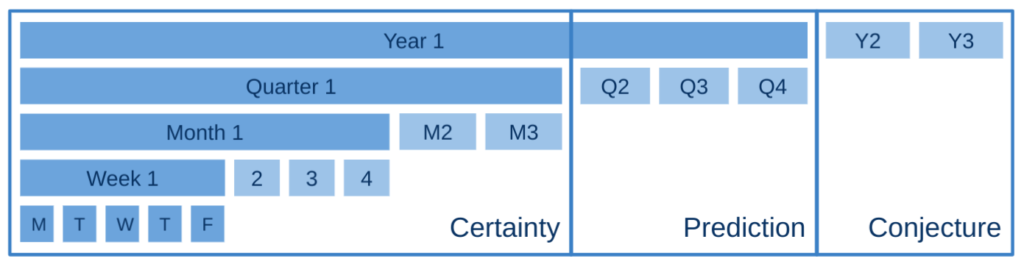
Break the three years down into thirds, then just the first year into quarters. Now break the first quarter down into months, and the first month into weeks. Finally break the first week into days. Now write a sentence or brief paragraph for each of the boxes you’ve created.
You now have the basic description of your journey and the beginnings of a strategy.
How you go about deciding on this content, and how you create and maintain a living strategy is a whole different story.